
Currys — Technical SEO Audit.
A targeted 'mini' technical SEO audit for Currys, delivered via Greenlight, covering the crawl and indexation fundamentals that matter most on a large ecommerce catalogue, where a single misconfigured rule can quietly block search engines from indexing thousands of product pages. Without indexation these pages were effectively opting out of ranking on Google!
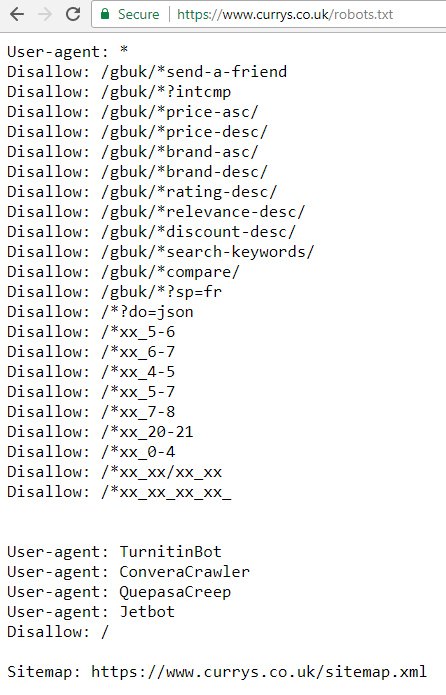
The audit's robots.txt review found a long list of Disallow rules blocking category filtering, sorting, and comparison parameters. Reasonable in principle, but broad enough that testing showed real product pages, including AMP versions, were being blocked from Google's crawler entirely.
As is often the case with larger organisations there was a number of disconnects between their marketing and technical teams, and an audit like this gives the marketing team the answers they need and a roadmap to addressing the problems (and also deciding a priority order that makes sense for the end client's business too) and recommendations on the best way to solve this disconnect.
Narrowing of the rules across their Robots.txt file and correctly mapping out and planning user journeys whilst making sure the AMP versions were not being blocked from indexation. Alignment on what marketing and technical are both trying to achieve was also part of the importance of this work.
This led to better (and more accurate) indexing of these pages and increases in impressions, average category rankings and indexation of said AMP page versions.
It is this evidence like this that is critical to drive changes in larger organisations that have multiple stakeholders involved and generally a lot of moving parts to consider and plan for.
What this covered
- Robots.txt Audit A full review of Disallow rules against real crawl behaviour, catching parameter-blocking rules that were unintentionally catching product and AMP pages too.
- AMP Crawlability Testing Google's AMP Test tool used to confirm which specific pages were being blocked, turning a robots.txt review from a static file read into evidence of real crawl impact.
- Site Search & Faceted Navigation Reviewing how filtering and sorting parameters were being handled, since this is usually where large ecommerce catalogues generate the most unintentional crawl waste.