
HSBC — Technical SEO & Site Architecture.
Technical SEO strategy work for HSBC's Retail Banking and Wealth Management (RBWM) division – a site of the scale and regulatory sensitivity where technical decisions carry real weight, and where "we think this will work" isn't good enough on its own.
The core of the engagement was three linked strategy documents: an internal linking and site architecture strategy, a duplicate content and canonicalisation strategy, and a 301 redirect impact assessment tied to a platform migration – each written to be defensible to stakeholders who weren't SEO specialists but needed to sign off on the approach.
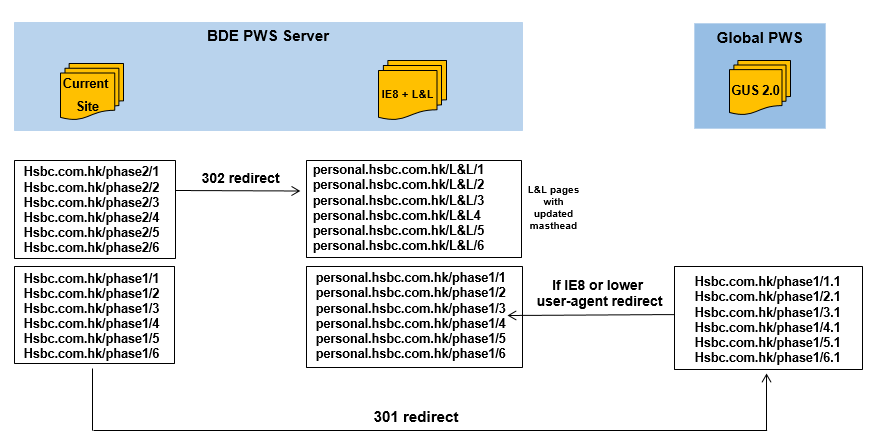
The redirect work centred on a phased migration between the legacy BDE PWS server (serving the current site and an IE8/L&L fallback) and the new Global PWS on GUS 2.0 – mapping which phase1/phase2 URLs needed 301s versus which legacy, lower-browser traffic needed a separate 302 path, so nothing lost link equity mid-migration.
The internal linking strategy argued for treating every RBWM PWS site as one interlinked network rather than isolated microsites, so authority from each homepage could flow to the subsections that needed it – and the canonicalisation strategy covered the standard trouble spots: paginated content, meta robots, and cross-domain duplication across HSBC's multilingual, multiregional sites.
What this covered
- Site Architecture Strategy Internal linking and information architecture recommendations designed around how a large regulated site should be structured for both crawl efficiency and user journeys.
- Canonicalisation Strategy A duplicate content and canonicalisation framework addressing the URL variants and parameter handling that large banking sites accumulate over time.
- Redirect Impact Assessment A 301 redirect impact assessment tied to a platform migration, modelling the SEO risk of the redirect approach before it shipped.